
09 Oct

Lubuntu 25.10 (Questing Quokka) Released!
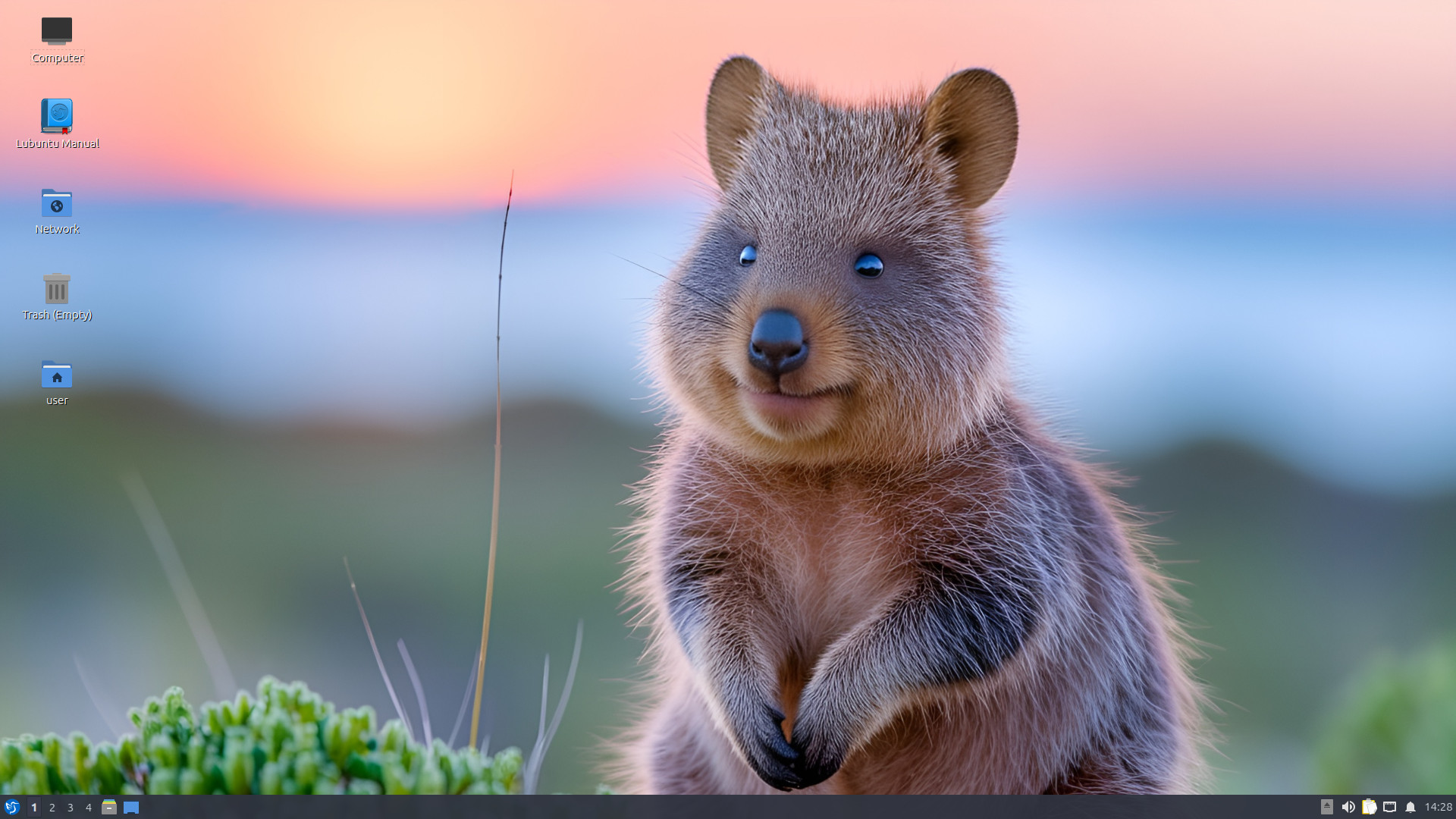
The Lubuntu Team is proud to announce Lubuntu 25.10, codenamed Questing Quokka. Lubuntu 25.10 is the 29th release of Lubuntu, the 15th release of Lubuntu with LXQt as the default desktop environment.

Download and Support Lifespan

With 25.10 being an interim release, it will follow the standard non-LTS support period of nine months; this means that Lubuntu 25.10 will be supported until July 2026. Our development focus going forward will be on Lubuntu 26.04 and future releases, so only critical bugfixes and security updates will be provided. If you’re a 25.04 user, please upgrade to 25.10 as soon as possible.

Installation

You can download Lubuntu 25.10 here. If you would like to upgrade your existing 25.04 installation, please visit our manual page describing the process. Common Ubuntu instructions can be found here.

New in Lubuntu 25.10

LXQt

LXQt 2.2 is now shipped by default. More information on its release can be found here: 2.2.0

rust-coreutils

Starting in Ubuntu 25.10, Ubuntu now uses the uutils Rust implementation of coreutils in place of the standard GNU coreutils. uutils is intended to be fully GNU-compatible, but reimplements the entire suite of OS components in Rust, providing better memory safety and (hopefully!) more robust code where the OS needs it most. As with any major change, this is not entirely without risk, and it is possible that users could see core system tools behave differently than they used to. If you notice a core system utility break or behave differently than expected, please file a bug report against rust-coreutils.

Note that findutils and diffutils have NOT been replaced with their Rust equivalents from uutils yet. find, xargs, and diff are still the original GNU versions, written in C.

sudo-rs

Along with coreutils, another important package that has been replaced with a Rust rewrite is sudo. Unlike uutils’ rust-coreutils however, sudo-rs is NOT fully drop-in compatible with the original sudo, and omits some features the developers have deemed to be “largely unused” or “only available for legacy platforms”. In particular, the -E option for passing through the current environment to the application executed with sudo is ignored by sudo-rs, and thus sudo -E application will oftentimes misbehave. Please be mindful of these changes if you notice sudo or a script or application that depends on it not behaving as expected.

Known Issues

  • When doing an OEM installation of Lubuntu, the system will not be able to enter the first-time user setup wizard unless you run “sudo apt install calamares” in a terminal within the OEM setup environment. Bug link.
  • If your system chooses to use the text-only bootup splash screen rather than the graphical splash screen for some reason, it will erroneously report that you are running Lubuntu 25.04. Bug link.
  • When installing onto a BIOS system with manual partitioning, one must select a non-default bootloader installation location on the manual partitioning screen, then re-select the default bootloader installation location. Failure to do so will result in an unbootable system. Bug link.

Common Release Notes

Please also check the Ubuntu Release Notes for more common issues and bugs affecting all Ubuntu flavors.

Technical Notes

Despite our original plans laid out in the 25.04 release announcement, Lubuntu 25.10 has ended up being a semi-boring release. We had substantially less development manpower than we’ve had for previous releases, thus our primary focus has been keeping Lubuntu working as well as it has worked historically, rather than innovating new features. As such, Lubuntu 25.10 continues to use the X11 display server, provides mostly the same set of apps as previous releases, uses the same theming, etc.

Some our our plans related to Wayland have changed as a result of this lessened manpower. Despite having prepared to switch to the Miriway compositor early on in Questing Quokka’s development, we do not have developers with sufficient amounts of free time to continue driving this initiative. Our current plans are to switch from X11 to labwc by default in 26.04, as labwc is a stable, well-established, Openbox-like Wayland compositor that we have experience with. We would love to use Miriway instead, but it simply isn’t feasible unless developers with sufficient experience and time are willing to help us make it happen.

We need help with development. Lubuntu is effectively in “maintenance mode” at this point, but we’d like to get back to developing full-speed. If you have spare time and wanted to get into open source development, please introduce yourself, we need you! The most vital areas we need help with are continuous testing of all of the features our installer offers, and fixing bugs discovered during that testing. Our developers are generally low on time, but can oftentimes give pointers to help with whatever you want to work on. The installer is stable for simple installation scenarios, but oftentimes issues can be dug up by playing with edge cases such as manual partitioning, OEM installation, and the like. If you’re already reasonably seasoned as Debian packaging, we would also greatly appreciate help there!

What is Lubuntu?

Lubuntu is an official Ubuntu flavor which uses the Lightweight Qt Desktop Environment (LXQt). The project’s goal is to provide a lightweight yet functional Linux distribution based on a rock-solid Ubuntu base. Lubuntu provides a simple but modern and powerful graphical user interface, and comes with a wide variety of applications so you can browse, email, chat, play, and be productive. You can find the following major applications and toolkits installed by default in this release:

You can find a variety of other applications installed which aim to enhance your experience while staying out of the way of your normal workflow. New features and bugfixes in core Ubuntu components can be found here.

Lubuntu Manual

The Lubuntu Team has been hard at work in polishing the Lubuntu Manual to make it easy for new and experienced users alike to use their system more productively. The manual can be found at manual.lubuntu.me. We want to thank Lyn Perrine for all the hard work she has put into the Lubuntu Manual. Thank you!

Versions of the Lubuntu Manual:

While the documentation for previous releases will be kept in the Git repository, they will not be published anywhere.

Want an easy way to access the manual? Just double-click the “Lubuntu Manual” icon on the desktop.

Lubuntu Project

How can I help?

We can always use more help! No matter your skill level or your technical experience, there’s something you can help with that can make a huge difference in Lubuntu. Join us on our Matrix chat and talk to us there. Whether you know another language, have some spare time to help us test Lubuntu, are good at writing documentation, or just want to stay “in the know,” that is the place to be. More information about contributing can be found here. If you want to contribute to Lubuntu but do not feel you have the time or skills, consider buying a t-shirt or donating to Lubuntu. Another great method to get involved is bug reporting. If you notice an issue, please file a bug using the instructions on the Lubuntu Wiki. Don’t want to file a bug? Let us know what the problem is (in detail, enough that we can reproduce it) and we can assist you in filing one or do it ourselves.

Contributors

We would like to thank the following contributors for dedicating their time to Lubuntu this cycle. Thank you!

We’d also like to thank previous (and hopefully future!) contributors to the Lubuntu project. We wouldn’t be where we are today without you!

We also wanted to give a special mention to Julien Lavergne, our Project Lead Emeritus and Founder. Without you, the Lubuntu project would not exist. Thank you.

Global Team

The Lubuntu Global Team has been created to foster communities in non-English languages and locales. An up-to-date list of our communities can be found on our Links page, but the existing groups include: Spanish, Portuguese, Russian, Italian, Chinese, German, Japanese, Arabic, and French. If you would like to start a language group, join our development channel and talk with the Global Team. At minimum, you should have a few interested drivers of the community, and at least one administrator that speaks English.

18 Sep

Lubuntu Questing Beta Released!

Thanks to all the hard work from our contributors, Lubuntu 25.10 Beta has been released. With the codename Questing Quokka, Lubuntu 25.10 will be the 29th release of Lubuntu, the fifteenth release of Lubuntu with LXQt as the default desktop environment.

Support lifespan

With 25.10 being an interim release, it will follow the standard non-LTS support period of nine months, which means 25.10 will be supported until July 2026. Please note that 25.10 is still in Beta, and is not officially supported until its scheduled release on October 9, 2025.

You can download 25.10 Beta here. If you would like to upgrade your existing 24.04 LTS or 25.04 installation, please visit our manual page describing the process. Common Ubuntu instructions can be found here.

Known Issues and Notable Changes

LXQt

LXQt 2.2 is now shipped by default. More information on its release can be found here: 2.2.0

rust-coreutils

Starting in Ubuntu 25.10, Ubuntu now uses the uutils Rust implementation of coreutils in place of the standard GNU coreutils. uutils is intended to be fully GNU-compatible, but reimplements the entire suite of OS components in Rust, providing better memory safety and (hopefully!) more robust code where the OS needs it most. As with any major change, this is not entirely without risk, and it is possible that users could see core system tools behave differently than they used to. If you notice a core system utility break or behave differently than expected, please file a bug report against rust-coreutils.

Note that findutils and diffutils have NOT been replaced with their Rust equivalents from uutils yet. find, xargs, and diff are still the original GNU versions, written in C.

sudo-rs

Along with coreutils, another important package that has been replaced with a Rust rewrite is sudo. Unlike uutils’ rust-coreutils however, sudo-rs is NOT fully drop-in compatible with the original sudo, and omits some features the developers have deemed to be “largely unused” or “only available for legacy platforms”. In particular, the -E option for passing through the current environment to the application executed with sudo is ignored by sudo-rs, and thus sudo -E application will oftentimes misbehave. Please be mindful of these changes if you notice sudo or a script or application that depends on it not behaving as expected.

Known issues

  • apt sometimes has odd behavior when resolving packages, choosing packages that one wouldn’t expect if presented with multiple choices that can satisfy a dependency. This has not been filed as a bug in Ubuntu, but has been filed as a bug in Debian. See the bug report here. Consider double-checking the list of packages that will be installed when installing new software. This behavior has resulted in two bugs in Lubuntu:
    • KWallet and KWalletManager are being installed by default instead of gnome-keyring: Bug link
    • Alacritty is being installed alongside QTerminal: Bug link
  • Some disk management packages (cryptsetup and btrfs-tools, possibly others) are no longer being preinstalled, causing KDE Partition Manager to complain in some instances.
  • Installing with manual partitioning on BIOS systems may result in an unbootable system. To prevent this, after setting up your desired partition layout, change the bootloader installation location to something other than its default value, then change it back. This will get Calamares to remember what disk it should install the bootloader to.
  • On OEM installations of Lubuntu, double-clicking the “Finish OEM preparation” icon will do nothing. This is because kdialog is not being pre-installed on accident. You may be able to work around this by running sudo apt install kdialog in the OEM session before double-clicking the icon.

Common Release Notes

Please also check the Ubuntu Release Notes for more common issues and bugs affecting all Ubuntu flavors.

What is Lubuntu?

Lubuntu is an official Ubuntu flavor which uses the Lightweight Qt Desktop Environment (LXQt). The project’s goal is to provide a lightweight yet functional Linux distribution based on a rock-solid Ubuntu base. Lubuntu provides a simple but modern and powerful graphical user interface, and comes with a wide variety of applications so you can browse, email, chat, play, and be productive. You can find the following major applications and toolkits installed by default in this release:

You can find a variety of other applications installed which aim to enhance your experience while staying out of the way of your normal workflow. New features and bugfixes in core Ubuntu components can be found here.

Lubuntu Manual

The Lubuntu Team has been hard at work in polishing the Lubuntu Manual to make it easy for new and experienced users alike to use their system more productively. The manual can be found at manual.lubuntu.me. We want to thank Lyn Perrine for all the hard work she has put into the Lubuntu Manual. Thank you!

Versions of the Lubuntu Manual:

While the documentation for previous releases will be kept in the Git repository, they will not be published anywhere.

Want an easy way to access the manual? Just double-click the “Lubuntu Manual” icon on the desktop.

Lubuntu Project

How can I help?

We can always use more help! No matter your skill level or your technical experience, there’s something you can help with that can make a huge difference in Lubuntu. Join us on our Matrix chat and talk to us there. Whether you know another language, have some spare time to help us test Lubuntu, are good at writing documentation, or just want to stay “in the know,” that is the place to be. More information about contributing can be found here. If you want to contribute to Lubuntu but do not feel you have the time or skills, consider buying a t-shirt or donating to Lubuntu. Another great method to get involved is bug reporting. If you notice an issue, please file a bug using the instructions on the Lubuntu Wiki. Don’t want to file a bug? Let us know what the problem is (in detail, enough that we can reproduce it) and we can assist you in filing one or do it ourselves.

Contributors

We would like to thank the following contributors for dedicating their time to Lubuntu this cycle. Thank you!

We’d also like to thank previous (and hopefully future!) contributors to the Lubuntu project. We wouldn’t be where we are today without you!

We also wanted to give a special mention to Julien Lavergne, our Project Lead Emeritus and Founder. Without you, the Lubuntu project would not exist. Thank you.

Global Team

The Lubuntu Global Team has been created to foster communities in non-English languages and locales. An up-to-date list of our communities can be found on our Links page, but the existing groups include: Spanish, Portuguese, Russian, Italian, Chinese, German, Japanese, Arabic, and French. If you would like to start a language group, join our development channel and talk with the Global Team. At minimum, you should have a few interested drivers of the community, and at least one administrator that speaks English.

22 Apr

Lubuntu 21.04 (Hirsute Hippo) Released!

Thanks to all the hard work from our contributors, Lubuntu 21.04 has been released. With the codename Hirsute Hippo, Lubuntu 21.04 is the 20th release of Lubuntu, the sixth release of Lubuntu with LXQt as the default desktop environment.

Support lifespan

Lubuntu 21.04 will be supported until January 2022. Our main focus will be on this and future releases.

Lubuntu 20.04 LTS will be supported until April 2023. For 20.04 LTS, we are limiting changes to critical fixes and underlying system changes shipped with all other Ubuntu flavors.

What is Lubuntu?

Lubuntu is an official Ubuntu flavor which uses the Lightweight Qt Desktop Environment (LXQt). The project’s goal is to provide a lightweight yet functional Linux distribution based on a rock-solid Ubuntu base. Lubuntu provides a simple but modern and powerful graphical user interface, and comes with a wide variety of applications so you can browse, email, chat, play, and be productive.

You can find the following major applications and toolkits installed by default in this release:

  • LXQt 0.16.0 – with many improvements over 0.15, you can go here for more information.
  • LXQt Archiver 0.3.0 which is based on Engrampa, is now included.
  • Qt 5.15.2
  • Mozilla Firefox 87.0, which will receive updates from the Ubuntu Security Team throughout the support cycle of the release.
  • The LibreOffice 7.1.2 suite.
  • VLC 3.0.12, for viewing media and listening to music.
  • Featherpad 0.17.1, for notes and code editing.
  • Discover Software Center 5.21.4, for an easy, graphical way to install and update software.

Our update notifier application received an update. The new update adds the packages and versions to the tree view to see the pending updates better. In addition, Update Notifier now has a separate tree view for security updates. Update Notifier was developed by Lubuntu Member Hans Möller. Update Notifier also lets you update your system from within the application itself.

You can find a variety of other applications installed which aim to enhance your experience while staying out of the way of your normal workflow.

Read More

04 Feb

Lubuntu 20.04.2 LTS Released!

Thanks to all the hard work from our contributors, we are pleased to announce that Lubuntu 20.04.2 LTS has been released!

What is Lubuntu?

Lubuntu is an official Ubuntu flavor which uses the Lightweight Qt Desktop Environment (LXQt). The project’s goal is to provide a lightweight yet functional Linux distribution based on a rock-solid Ubuntu base. Lubuntu provides a simple but modern and powerful graphical user interface, and comes with a wide variety of applications so you can browse, email, chat, play, and be productive.

Read More

12 Feb

Lubuntu 18.04.4 Released!

Thanks to all the hard work from our contributors, we are pleased to announce that Lubuntu 18.04.4 LTS has been released!

What is Lubuntu?

Lubuntu is an official Ubuntu flavor which uses the Lightweight X11 Desktop Environment (LXDE). The project’s goal is to provide a lightweight yet functional Linux distribution based on a rock solid Ubuntu base. Lubuntu specifically targets older machines with lower resources, but also runs great on newer hardware. Along with a simple but usable graphical user interface, Lubuntu comes with a wide variety of applications chosen for their small footprint so you can browse, email, chat, play, and be productive.

Where can I download it?

You can download Lubuntu 18.04.4 LTS on our downloads page.

This announcement on our official website (Lubuntu.me, NOT Lubuntu dot net, which is not run by Lubuntu contributors) replaces the traditional release notes we have provided in the past on the wiki. We have left out some notes that are common to all flavors, so we recommend that you read the Ubuntu release notes.

What’s The Difference Between Lubuntu 18.04.3 LTS And This Release?

Lubuntu 18.04.4 is a set of images produced for convenience so that a fresh install of the latest Lubuntu LTS does not require as many updates after install (as Lubuntu continues to release Stable Release Updates and security fixes to make your experience as smooth as possible and to fix any bugs, if you want to help us out with this, see below, we always need more help). If you do system updates regularly, you are already running Lubuntu 18.04.4 LTS, and if you install Lubuntu on a system using a Lubuntu 18.04.3 LTS image or a previous point release and do system updates, that system will also then be running Lubuntu 18.04.4 LTS.

At this time, this will be the last planned 18.04 release for Lubuntu, thus also making it both the last LXDE release as well as the last i386 release.

How do I get support?

You can get support for Lubuntu here.

How do I help?

We always need more help! Feel free to join our development channel (which is bridged three ways to Matrix, Telegram, and IRC) and talk to us there. Whether you know another language, have some spare time to help us test Lubuntu, are good at writing documentation, or just want to stay “in the know,” that is the place to be.

Known Issues

Bug 186192  If there is less free space on the target drive than the USB install media, the installer may attempt to install to the USB drive while it is being used. Due to this we recommend not utilizing the install alongside option unless there is sufficient free space.

Did we miss something? Please file a bug and tag it with “lubuntu”. You can find out more about filing bugs at our wiki page.

Don’t want to file a bug? Let us know what the problem is (in detail, enough that we can reproduce it) and we can assist you in filing one.

Thanks to our testers!

Huge thanks to Chris Guiver (guiverc), Leó Kolbeinsson (leoK), Bill (franksmcb) from the Mate team, and others for testing this release.

12 Jan

Lubuntu 19.04 End of Life and Current Support Statuses

Lubuntu 19.04 (Disco Dingo) will reach End of Life on Thursday, January 23, 2020. This means that after that date there will be no further security updates or bugfixes released. We highly recommend that you update to 19.10 as soon as possible if you are still running 19.04.

After January 23rd, the only supported releases of Lubuntu will be 18.04, with LXDE, and 19.10, with LXQt. All other releases of Lubuntu will be considered unsupported, and will no longer receive any further updates from the Lubuntu team.

You can find instructions on how to upgrade your Lubuntu installation here at our manual page.

Note, due to the extensive changes required for the shift in desktop environments, the Lubuntu team does not support upgrading from 18.04 or below to any greater release. Doing so will result in a broken system. If you are on 18.04 or below and would like to upgrade, please do a fresh install. The installation image can be obtained from our downloads page.

12 Mar

Statement Regarding Infrastructure Data Loss

At 2:15 AM Central US Time, the Lubuntu Team was informed by our hosting provider, Altispeed Technologies, that there had been a problem with the server we use for Lubuntu’s infrastructure, including Phabricator, Weblate, Jenkins, the IRC bridge and other services. This resulted in complete data loss for all of the aforementioned services. Below is a statement from Altispeed Technologies regarding the incident:

In an effort to demonstrate good stewardship of Linux and open source,
Altispeed Technologies donates the server, storage space, and bandwidth for
hosting many of the Lubuntu resources. During a migration effort last night,
the virtual machine that stores production data for the Lubuntu Phabricator
instance (among other services) was inadvertently destroyed. Despite having
backups enabled, our VPS provider was unable to recover the data and it has
been permanently lost.
Our team is working to re-provision the system and we have signed an
agreement with a datacenter to run our services under our control. All
Lubuntu resources hosted by Altispeed will be moved at that time. We
apologize for any inconvenience this may have caused and will continue to
work towards giving back to the community.

We still have complete access to the Git repositories hosted on the Phabricator instance, as they have been mirrored to GitHub, however, all of the tasks on our Phabricator instance as well as the wiki and login information for all users has been lost.

We sincerely apologize for the inconvenience, and expect services to be back up before the end of the day Central US time. On a positive note, starting anew has allowed us to refine the way the services are organized on the server, to offer a faster and more secure experience going forward.

19 Jan

Introducing the Lubuntu Council

The Lubuntu community has grown exponentially since our switch to LXQt. With new users, contributors, and Lubuntu enthusiasts among many other people who have decided to join our community, we are finding the need to scale the project further than the unwritten technically-led oligarchy that we currently have in the Lubuntu project. Therefore, we are pleased to announce the Lubuntu Council.

Read More